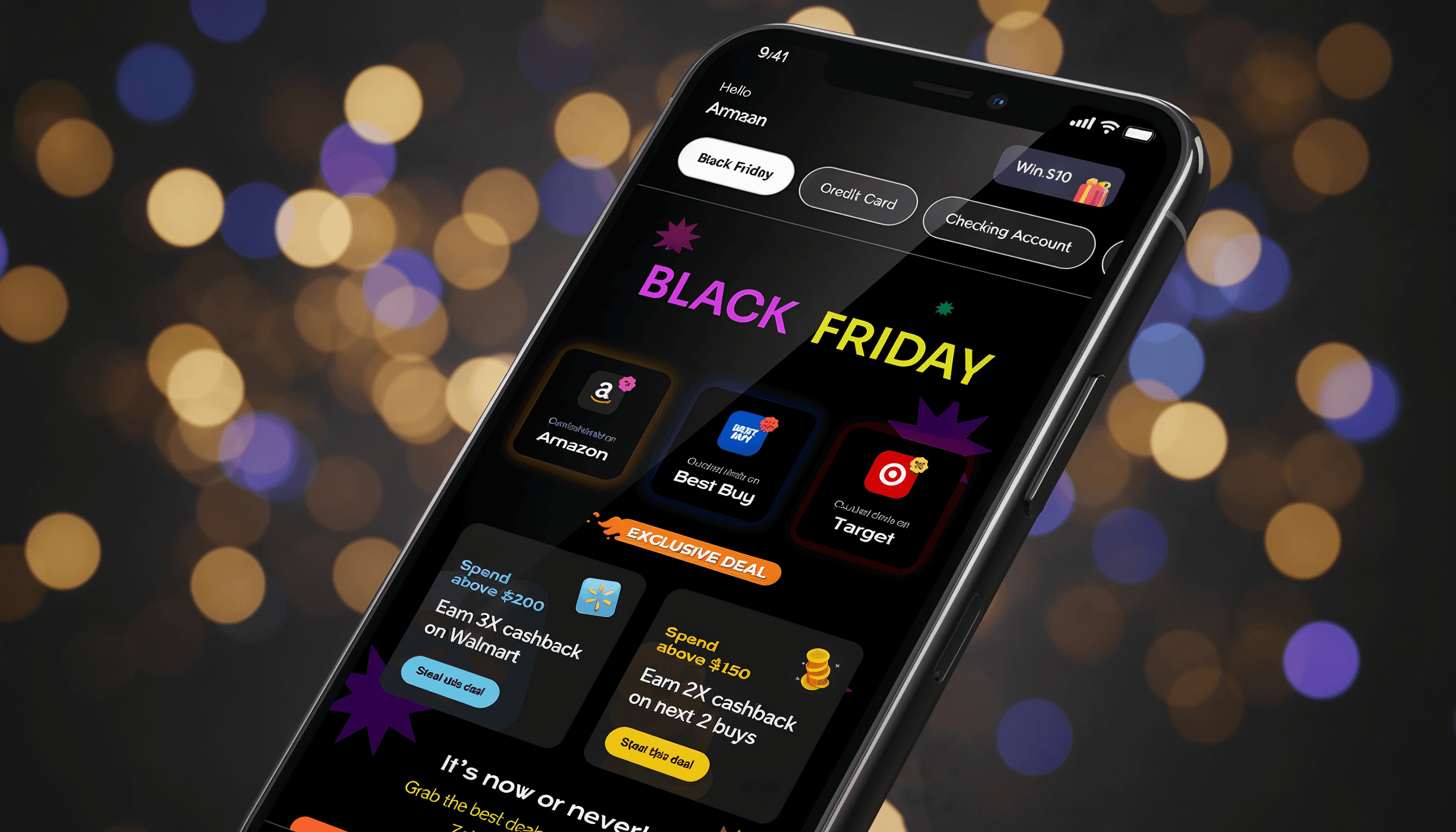
Black Friday, Zero Releases:
Shipping a Revenue-Critical Surface in 24 Hours
Re-architected the home experience using server-driven UI to launch time-boxed offers,
without an app update
Team
1 PD, 2 PMs, 2 Devs
Timeline
T-24h to go-live
My role
Product design lead
About Zolve
Series B; $850 Mn; 750,000 customers; $1.2 billion in transactions; Founded 2021
Zolve is a neobank serving international students and immigrants who cannot access US banking due to lack of credit history or Social Security Numbers. Using passport-based underwriting, they provide instant US credit cards and bank accounts.
Problem Context
Black Friday traffic was arriving in <24h. We needed a new deals surface without an app release so users on old builds still saw time-boxed offers.
Constraints
No client release allowed
Minimal IA disruption
≤1 extra tap
Must be measurable in real-time
Approach
My Role: I led the product design direction, defined the SDUI JSON contract, and coordinated the 24‑hour design‑to‑release cycle with PMs and developers.
Leveraged the existing SDUI stack as part of the solution to enable dynamic, server-controlled UI updates without client releases.
Audited all entry points and chose to set the Offers tab as default on Home—guaranteeing visibility on first open.
Why it worked
Direct discoverability
No added latency
Minimal backend change
Guardrails
Auto reset post-event
Pinned offers limited to 3
Measured drop-off per session
Designs
Design goal: Bring SDUI-driven flexibility into the interface so new promotions could be launched instantly, while ensuring users intuitively discover offers first.
Quick context: SDUI (Server‑Driven UI) lets the backend define what the app shows using JSON instead of hardcoded layouts. It enables instant design or content changes—no release needed.
System-led Design Thinking
Every design decision mapped back to the JSON schema defined in the Approach, letting the server control the layout dynamically. My role was to design these as reusable, schema-aligned blocks that engineering could plug into the SDUI renderer without extra front-end work.
IA & Entry
Temporary default tab: Offers (reverts post‑event)
Secondary entry points: banner + inbox (emphasized during event)
Motion & Feedback
We added micro-motion via Lottie animations tied to lightweight JSON references (<400KB). The same design logic applied across devices—animations loaded only when referenced in the config.
Outcomes & Attribution
Results (72 hours)
Black Friday: Approximately $3 million in spend, with more than 20,000 active transactors.
Cyber Monday: ~$1.8 million, engaging ~14,000 participants.
Travel Tuesday: ~$1.4 million, including ~$100k from travel‑specific transactions.
Reactivation: >1,000 dormant accounts re‑engaged, yielding nearly $200k.
Aggregate Effect: Across all events, nearly $6.9 million was facilitated. While transactors were not mutually exclusive, the intervention demonstrably scaled engagement and revived previously inactive cohorts.